
Soil and structural modeling and monitoring, intelligent systems
The MS3I division is interested in the same objects and themes as the other divisions of the IMSE laboratory, focusing on the scale of the structure, the neighborhood, and the city.
Activities
Direct modeling
The IMSE laboratory leads the development of the CESAR finite element calculation software, dedicated to the modeling of civil engineering structures in the broad sense. The project includes several components:
- the CESAR solver is the core calculation engine itself,
- the CESAR Pilot is a Python textual interface, developed for research applications, which allows organizing and structuring calculation data and results (https://cesar.univ-gustave-eiffel.fr),
- the CESAR-LCPC software package, consisting of the combination of the solver with graphical pre- and post-processors for Windows and distributed by the company Itech (https://cesar-lcpc.com).
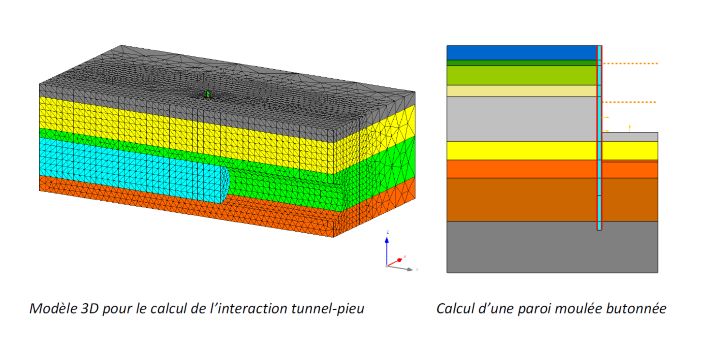
CESAR notably allows for nonlinear mechanical calculations in various fields: in recent years, a number of developments have been carried out to address issues related to the construction of stations and tunnels for the Grand Paris Express, particularly within the TULIP project (https://www.societedugrandparis.fr/gpe/actualite/impact-creusement-tunnelier-sur-fondations-profondes) and the ANR E-Pilot project (https://e-pilot.univ-gustave-eiffel.fr/ ).
Structural Monitoring
The IMSE laboratory is involved in numerous projects that include measurements to better understand the real behavior of structures, with various applications.
As part of the "Connected Bridges" call for projects, led by Cerema (https://www.cerema.fr/fr/pontsconnectes), the IMSE laboratory, together with Sixense, the Lot departmental council, and Cofiroute, set up the "IA2" project aimed at detecting bridge pier scour using sensors. The project combines instrumentation of structures with data assimilation techniques (the detection of bridge pier scour is also the subject of S. Hachem's thesis, which is based on the calculation of spectral perturbations https://theses.ifsttar.fr/candidats/sujet.php?num=2504).
The IMSE laboratory is also working on the design of structural protection systems. The use of dampers to increase the fatigue life of stay cables subjected to vortex-induced vibration has recently been studied in collaboration with CEREMA for CD 44.
Urban Network Management Strategies
The transition to the smart city requires efficient management of infrastructure and various citizen services, particularly the distribution of electrical energy, through intelligent systems capable of controlling critical parameters, ensuring safety and connectivity, adapting to current states, and integrating the possibility of remote supervision and management.
The implementation of these systems requires the use of communicating and multi-parameter sensors integrated into infrastructures, delivering real-time information. The collected data can be used for structural health monitoring and to alert about infrastructure anomalies, such as extreme mechanical loads, the appearance of cracks, or abnormal temperature rises. The combination of high-performance sensors and artificial intelligence techniques for data processing will enable the development of innovative solutions for the city of tomorrow. Photonic sensors, especially those based on optical fibers, are a key element in this division.
In the resource-efficient smart city, the optimal integration and management of renewable energy sources as well as electric vehicles in urban power grids represent a major challenge. The incorporation of microgrids, energy storage systems, and new control systems into conventional power grids can greatly improve their performance. To ensure the safety, quality, and stability of local network supply, it is necessary to implement appropriate distributed control strategies based on mathematical models under real operating conditions, with practical implementation.
Advanced Materials for New Constructions
Future infrastructures will be made of multi-materials (functional and/or structural, judiciously chosen), with very low maintenance, equipped with highly reliable structural health monitoring means, and making extensive use of nanomaterials and nanotechnologies. Moreover, prior to real use, mastering durability according to environments and operating temperatures of such assemblies will be absolutely essential. One of the division's themes is the development of advanced materials for new constructions, offering high mechanical properties and the ability to provide reliable continuous information on their structural health. The interest is directly related to the Smart Cities environment (energy, mobility, safety, and security). Application fields include renewable energies, particularly offshore wind (EVEREST project), infrastructure safety and security, an area of collaboration with Europe (REHSTRAIN project on very high-speed linear transport) and the United States.
Experiments on the intelligent composite materials testing platform, which will be located on the MLV site, will be carried out. They will involve tests on vibrational properties, damping by shape memory alloys, and embedded core sensors.
Very high voltage power transmission cables for offshore farms are being studied. The primary aim of these studies is to develop online diagnosis and monitoring of very high voltage submarine cables. Thus, obtaining specific information on cable aging, health status, and physical behavior helps to avoid failures. These scientific topics are being developed within the following projects: ANR EMODI and European FLOW-CAM.