
Simulation, measurement and analysis of urban phenomena and the urban environment
SIMAPE brings together researchers working on measurement, instrumentation, simulation, representation, and experiments dedicated to the city and territories.
This research is applied to urban issues such as thermal performance, water and air quality, and the urban climate. Different scales are studied, ranging from the sensor to the neighborhood.
Numerical approaches are used in various application fields. The focus is on the design of new sensors, sensitivity analysis, reduction of computation times through so-called "reduced basis" mathematical approaches, the development of efficient numerical methods, and the understanding and representation of urban physical phenomena.
Empirical approaches based on physical measurements are also carried out to improve knowledge—of sensors, materials, or phenomena—but also for the parameterization and improvement of models.
IMSE researchers conduct experiments in real conditions in territories such as the Paris La Défense district or in the Sense-city demonstrator.
ACTIVITIES
New sensors
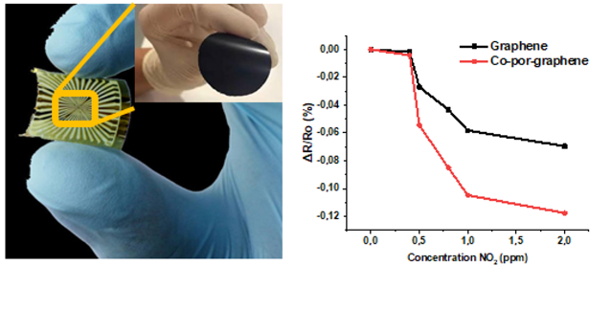
As part of ERC Nacre, we are studying the development of a new generation of gas chemical sensors based on nanomaterials (carbon nanotubes and 2D materials), which are highly sensitive, selective to a specific gas, easily transportable, low energy consumption, and low cost. We study the entire chain from the synthesis of nanomaterials to the development of high-performance portable gas sensors. After validating laboratory tests, we will study the integration of these sensors into communicating systems in order to validate their performance in real conditions within the Sense City framework. The experimental part is complemented by a theoretical study.
Researcher: Fatima Bouanis
Electronic tongue and nose with carbon nanotubes for water and air quality
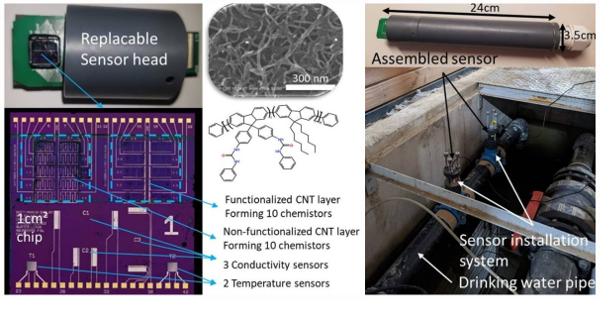
Health and environmental issues require the measurement, at low cost and with high precision, of a large number of physico-chemical parameters of air and water in complex and harsh environments. Nanomaterials, especially carbon nanotubes, organized as electronic noses and tongues—that is, as very dense matrices of micro-sensors—have proven in the laboratory to be a preferred solution for this type of application, but there are scientific and technological challenges to overcome for their deployment in real environments. The work aims to address these challenges: it includes, in particular, the numerical design of new sensors (ab-initio methods), the reproducible fabrication in small and medium series of electronic tongues and noses with carbon nanotubes (including pre-industrialization), the integration of these sensors into end-to-end Internet of Things solutions, their deployment and validation in the laboratory and in realistic or even real environments, and finally the implementation of advanced algorithmic tools for calibration and exploitation of the produced data.
Researcher: Berengère Lebental
Projects: H2020 LOTUS, HE HS4U, ANR CARDIF, Hydroscope, SenseBiotek
Uncertainty quantification and sensitivity analysis
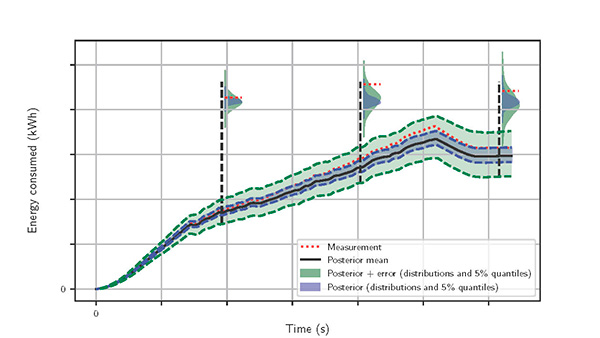
Uncertainty quantification and sensitivity analysis aim to best characterize the confidence that can be attributed to a prediction, whether it comes from physical or numerical experiments. Intrinsically interdisciplinary, these two topics rely on mathematical and statistical analyses, as well as on specific algorithmic and computer developments, and are particularly important when working with potentially imprecise models and insufficient data, as is the case when developing new sensors.
Researcher: Guillaume Perrin
Projects: H2020 LOTUS, HE HS4U, ANR CARDIF
Physical modeling and numerical methods applied to thermal performance and air quality
In an urban monitoring approach, the number of deployed sensors is generally very limited due to cost, maintenance, space requirements, etc. The modeling and numerical simulation of urban physical phenomena can help compensate for this lack of measurements. Thus, the digital twin is a promising tool for a better understanding of the multi-physics and multi-scale complexity of the city.
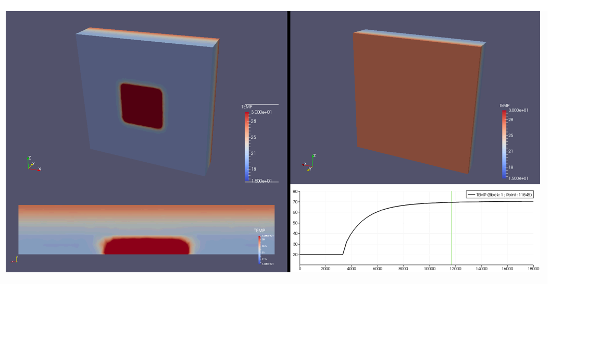
Within the IMSE laboratory, numerical methods combining measurement and physical modeling based on partial differential equations are developed and applied to various urban issues (e.g., air quality, thermal performance) at different scales (wall, building, neighborhood). Numerical optimization and the solution of inverse problems are used to intelligently position urban instrumentation, detect anomalies, map physical descriptors, and select relevant urban developments. To validate the proposed methods, experiments are carried out in the Equipex Sense-City and in demonstrators on real sites.
Researcher: Julien Waeytens
Projects: FUI MIME-SYS, E3S, ANR RESBATI, ANR RESBIOBAT.
Reduced basis methods for urban environment modeling
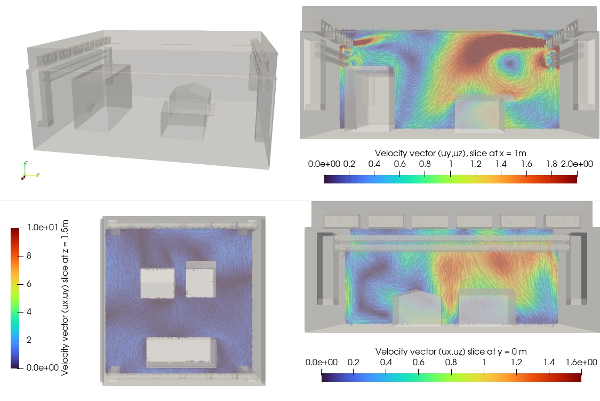
Among our research work, part focuses on the study and development of new reduction methods centered around the following objective: To propose numerical methods for solving parameter-dependent problems that are non-intrusive, low-cost, robust, and efficient.
These numerical methods are applied, among other things, to building thermal modeling, turbulent flow simulation, and pollutant dispersion modeling.
Researcher: Rachida Chakir
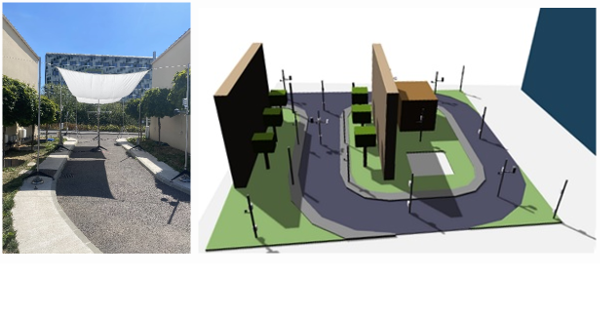
Analysis of heatwave situations and cooling solutions
Among our research work, part focuses on the study and development of new model order reduction techniques centered around the following objective: To propose numerical methods for solving parameter-dependent problems that are non-intrusive, low-cost, robust, and efficient.
These numerical methods are applied, among other things, to building thermal modeling, turbulent flow simulation, and pollutant dispersion modeling.
Researcher: Anne Ruas
Projects: MTE-RDT REPEXTREM; i-site FRAICHEUR; ADEME FRESHWAY
Demonstrators and Living-lab – the Sense-city case: urban demonstrator
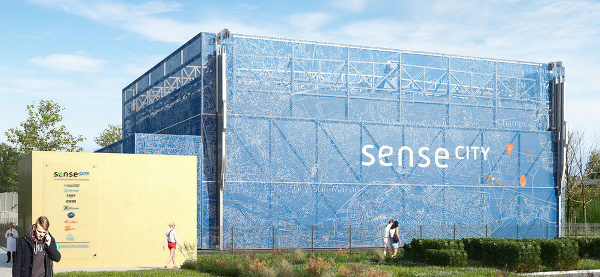
Sense-city is a center of excellence, funded by PIA 3. It consists of two small neighborhoods of 400 m2 each and a dense network of calibrated sensors. One of the two neighborhoods is made up of a concrete building, a wooden house, and a house insulated with wood fiber, two water networks, and a geothermal network. The other neighborhood consists of a canyon street, a rammed earth building, rain trees, and a water garden. Each neighborhood can operate in the open air or in a removable climatic chamber allowing control of weather conditions.
The data collected by the various sensor networks and obtained through numerical simulation can be integrated into advanced monitoring systems for cities and territories.
Potentially innovative solutions are prototyped and evaluated on the Sense-City platform in connection with the development of simulation tools (with the objective of reaching TRL 5).
Sense-City Team
Director: Stéphane Laporte
Experimentation Engineer: Yan Ulanowski