
Physico-chemistry, nanoscience, and quantum technologies
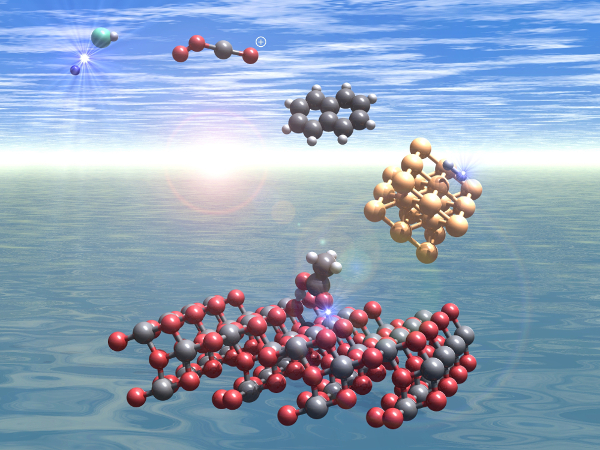
The latest advances in computational physico-chemistry make it possible to study complex problems that are only partially accessible by experiment. Thanks to the current computing power of high-performance computing stations, accurate simulations of the spectroscopy and reactivity of increasingly large molecular systems are now possible. Among the advantages of in silico approaches over experiments are the possibility of a better theoretical understanding of the phenomena studied, and the validation of the methods and procedures used. In addition, ab initio modeling allows the correct assignment of high-resolution spectra of small and medium-sized molecules, ions, and complexes, in atmospheric or solvated environments, and their simulation for future detections.
Quantum-mechanical calculations are increasingly used for the design and description of the behavior of materials. With these tools, it is possible, for example, to predict the chemical, electromechanical, optical, and thermodynamic properties of these systems from the atomic scale.
Applications
Ab initio study of isolated and embedded systems
This is a research activity focused on theoretical chemistry, molecular physics, and their applications in astrochemistry, planetary chemistry, and the study of elementary reactions in homogeneous or heterogeneous phases. Thus, our work focuses on modeling the spectroscopic properties of small and medium-sized molecular systems, isolated or in an environment (for example, interacting with a surface), and their reactivity. This involves:
- Determining the electronic and ro-vibrational structure of these molecular systems for their detection in the laboratory, in the atmosphere, or in astrophysical environments. We also deal with molecular systems of environmental or biological interest.
- Characterizing at the microscopic scale the strong (covalent, ionic) and weak (hydrogen bond, van der Waals) interactions that govern the structure and reactivity of such systems.
- Validating theoretical approaches after comparison with the most accurate experimental results.
Sensors and nanosensors
The aim is to prove the reproducibility and reliability of nanosensors based on three axes:
- Reproducibly manufacture – through a fine understanding of the processes – innovative nanosensors via “low-cost” technologies.
- Evaluate and understand the reliability of these mesoscopic objects for real applications via:
- Multi-scale and multi-physics characterization and modeling – including the development of new tools when existing ones are insufficient.
- Field deployment of technologies, supported by Internet of Things tools – often in partnership with specialized partners.
- Improve their design, performance, and reliability by using Artificial Intelligence tools in a way compatible with “Small Data” constraints.
Quantum technologies
The aim is to exploit the superposition and quantum entanglement of the states of physical or chemical systems, enabling the design of supercomputers and innovative sensors, the quantum simulation of atoms within molecules, and the securing of communications. The power of quantum computers would make it possible to solve major problems in several fields, such as the fight against climate change. This is reflected in the following areas:
- Research into the best CO2 sequestration and conversion systems
- Identification of economically viable processes for the parallel production of useful by-products such as hydrogen or carbon monoxide.
- Cold atoms and molecules (production, spectroscopies, and collisions).
- Artificial intelligence applied to biological activity and drug design.
Quantum photonics
Quantum photonics lies at the heart of the “new” quantum technologies. Indeed, quantum well or quantum dot lasers can be explored for the generation of optical frequency combs, for example: this concept can greatly improve the performance of fiber optic sensors, in terms of sensitivity, spatial resolution, and maximum range. A collaboration has begun in this direction between the IMSE Laboratory and TELECOM SudParis.