CIRC-BOOST
CIRC-BOOST is a four-year project (2023–2027), funded under the Horizon Europe programme, which focuses on testing and scaling up circular solutions in the building and construction sector through five pilot projects rolled out across different regions of Europe. The pilot projects will demonstrate, on a large scale, new and integrated solutions for demolition, the treatment of construction waste, and the management and recovery of materials for use in new products.
Its objective: to ensure sustainability, industrial competitiveness and a more efficient use of resources in European construction.
This collaborative project, organised by Cap Digital, COSYS and GERS, brings together, within the Université Gustave Eiffel, all the university’s research laboratories involved in materials and processes for the recovery of waste from demolition and the construction sector.
The consortium for the French pilot (Paris) comprises the Greater Paris Metropolis, the CSTB, NGE, Eiffage, Cap Digital, and Gustave Eiffel University, with the following research units:
GERS, COSYS, MAST, MSME, LIGM and the ECMU Chair (https://chaire-ecmu.univ-gustave-eiffel.fr/)
IMSE is leadind innovative approaches to the assessment of construction waste recovery solutions. The research key of this work is the use of Life Cycle Assessment (LCA) as a tool for optimising and evaluating solutions, combined with more traditional modelling methods, performance assessments, mechanical and thermomechanical analyses, etc., as well as socio-economic indicators.
A retrospective assessment of the E3S project (Chatenay-Malabry Eco-neighbourhood, Eiffage) was carried out using alternative construction scenarios. The benefits of substituting recycled concrete aggregate for natural gravel are relative. However, various alternative solutions were studied, notably timber structures and eco-sourced or geo-sourced materials. Finally, a functional analysis of existing pre-1948 buildings in the Paris region was carried out to assess, using LCA, the environmental impact of Haussmann-style buildings.
LCA is also used to optimise the operation of physical waste recovery and recycling platforms in the Greater Paris area. This work will enable the recycling of larger quantities of aggregates and the optimisation of processes through a systemic approach that takes into account the platform’s own environmental impact and the recycling of materials leaving the platforms.
A 1:3 scale demonstrator will be tested within Sense-City to assess the thermo-mechanical performance of a building constructed by Eiffage using recycled stabilised inert soil, thereby fully demonstrating the environmental benefits of the solution.
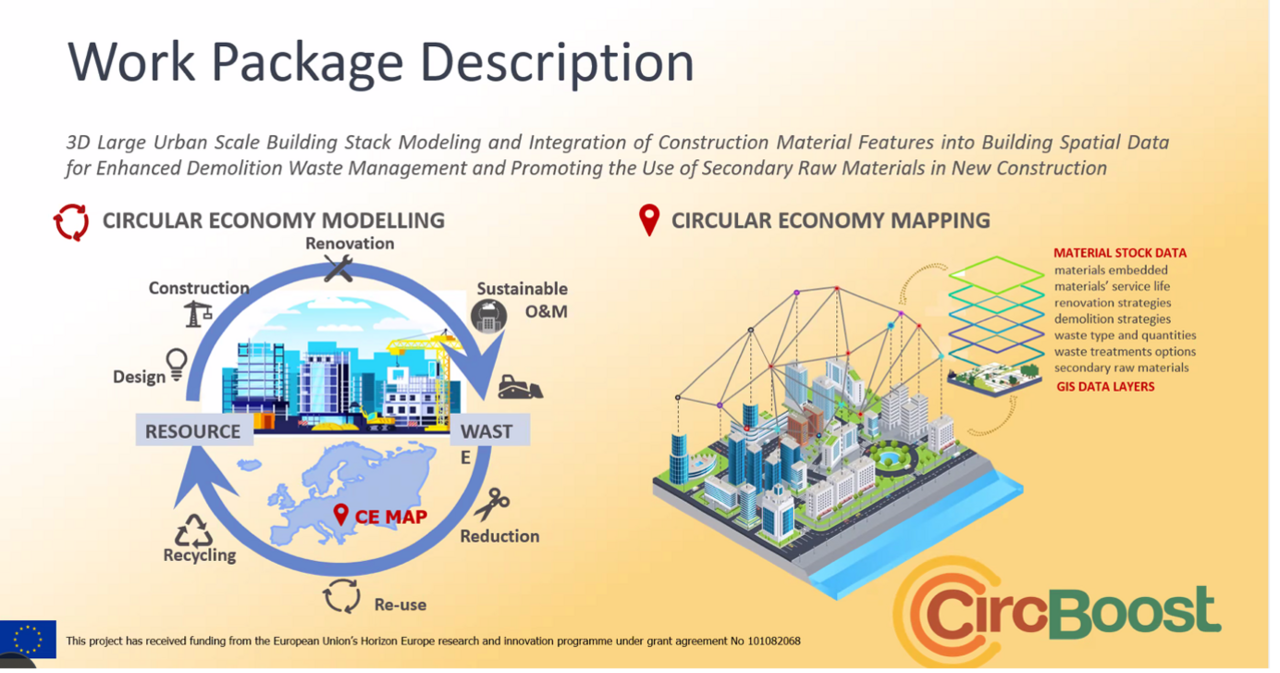
Finally, to ensure shared Digital Twins within the UGE, a digital development enables the use of a building BIM to identify resources prior to deconstruction and thus direct these flows towards reuse or recycling.
This Digital Twin is a tool for building management and optimisation. It can therefore be utilised not only for research, but also for training at the University.