Newtun
Partners : Soletanche Bachy, EGIS Structures et Environnement, RATP, TELEMAC, ITECH, ARMINES, IFSTTAR, IBISC

Context and positioning
One of the main challenges for sustainable cities is to control urban sprawl. This sprawl leads to a society dependent on individual transport, traffic congestion, and pollution.
In mainland France, after several decades of slowing urbanization, the area of urban space expanded by 19% between 1999 and 2010. Cities now occupy more than one fifth (22%) of the territory, and more than three out of four French people (77.5%) live in an urban municipality. The new city model is that of a more compact city, contained within its current limits, and with a denser public transport network. Given the lack of space in today’s cities, there is a growing use of underground infrastructure worldwide. These infrastructures are subject to severe environmental constraints, in particular they must not impact existing structures.
For developers, tunnel construction is a particularly difficult activity to consider. It is always likely to cause damage to surrounding structures. Often, surface settlements result in cracks or deformations that can prove very costly: repairs, project delays, and loss of trust from local residents. More serious incidents can also occur, due to unexpected soil conditions or unfortunate decisions: loss of life, evacuation of endangered buildings, work stoppages, and economic losses. For project owners, this threat makes underground works difficult to insure and to integrate into development plans.
In this context, the Newtun project, supported by the FUI, implements a multidisciplinary approach: engineering, construction methods, tools and equipment, and instrumentation to provide ways to better control surface settlements caused by the excavation of shallow tunnels using the traditional method.
It brings together many partners: Solétanche-Bachy (leader), Egis, SolData, RATP, IBISC, Itech, and IFSTTAR.
Content
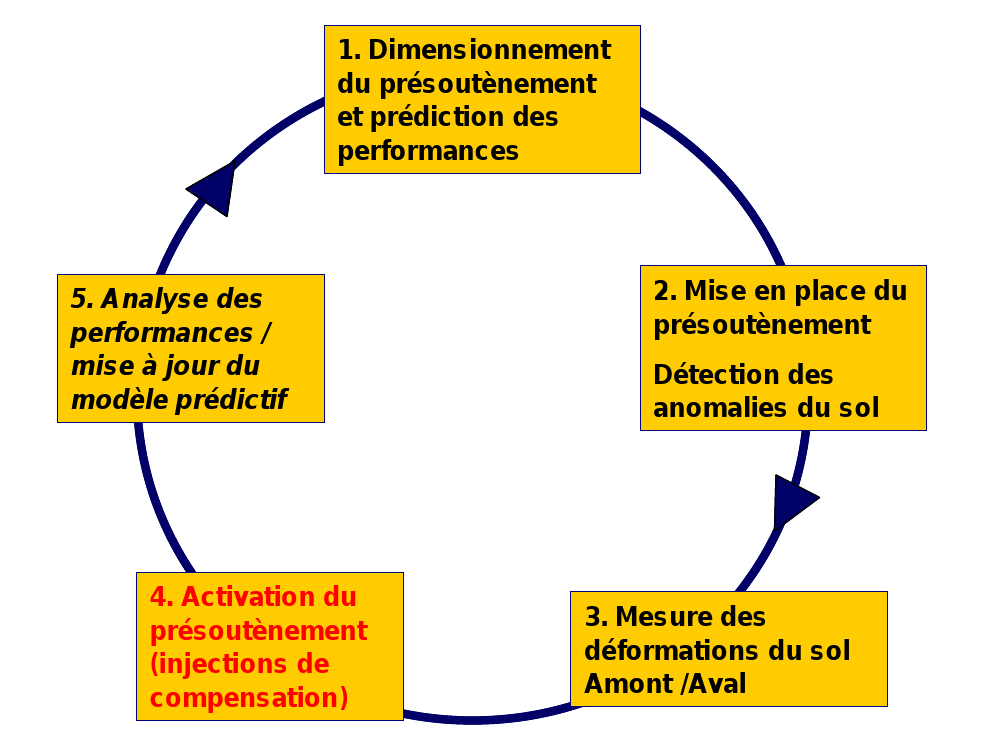
The soil is a natural, highly heterogeneous material whose characteristics are never well known in advance. The design of geotechnical structures is largely conditioned by this uncertainty, and the Observational Method currently provides the best response for optimizing the design of structures (as well as costs and schedules) while maintaining safety. In this method, the parameters of the excavation method are constantly revised and adjusted based on the reactions observed in the field. Hence, i) the need for simple design tools to revise the project as work progresses, and ii) the need to develop means to directly measure deformations ahead of the face.
The project uses the volume loss indicator as a guiding thread. Easy to assess in the field, this indicator is already widely used in projects to predict the magnitude of settlements and their zone of influence. It is also used in some contracts to set performance targets for companies. This indicator makes it possible to set a general objective for the NEWTUN Method: to achieve a volume loss coefficient of around 1% for excavation using the traditional method, i.e., comparable to the performance achieved by tunnel boring machines.
Sought innovation
- Interactive control of ground movements. The aim is to develop a new approach to tunnel excavation, called the NEWTUN Method, which involves implementing the observational method in the context of tunnels excavated without a tunnel boring machine.
- Design of pre-support structures
- Robotization of pre-support structures
- Instrumentation
Role of Ifsttar in the Newtun project
IFSTTAR contributes its expertise:
- in the field of understanding and modeling the behavior of natural or artificial materials during the construction of geotechnical structures (embankments, foundations, retaining structures, underground works),
- and in the development and maintenance of a finite element calculation code, CESAR-LCPC, which makes it possible to represent complex construction processes, taking into account realistic three-dimensional geometries, and to assess the performance of soil reinforcement techniques (by bolting, by rigid inclusions, etc.). This software will serve as the basis for calculations aimed at predicting settlements according to the techniques implemented, for example to reinforce the soil during excavation.
This dual approach reflects IFSTTAR's constant concern to compare models with observations made on structures, which in recent years has led to two multi-year research programs entitled "Effects of works in urban areas – observations and models" (2001-2004), and "Contributions to the control of movements related to urban works" (2005-2008).
The work carried out by IFSTTAR in the NEWTUN project will notably be carried out as part of the PhD theses of Nicolas Gilleron and Cédric Klotoe.