
RepExtrem
RepExtrem is an ARP project under the "Risk Decision Territory" call for proposals by the MEDDE
RepExtrem: Analysis and representation of heatwave episodes in dense urban areas
This project aims to design 3D hazard maps related to heatwave risk at the neighborhood scale.
It is based on the TEB urban heat island (UHI) calculation model developed by Météo-France, with several improvements:
- Increasing spatial accuracy by working with 100×100 m² grid cells
- Integrating the duration of phenomena, including past temperatures and forecasts
- Better accounting for spatial configurations, including building orientations
- Distinguishing between outdoor and indoor temperatures
The objective is to improve the description of impacts by integrating duration and spatial configurations to identify hazard zones and propose innovative graphical representations of heatwave risk.
| Coordinator | Anne RUAS |
| Partner 1 | IFSTTAR (French Institute of Science and Technology for Transport, Development and Networks) Anne Ruas; Laura Pinson (PhD): LISIS Laboratory (Laboratory of Instrumentation, Simulation and Scientific Computing) Katia Chancibault- EE (Water and Environment) |
| Partner 2 | CNRM-GAME (Atmospheric Meteorology Study Group) Valery Masson, Aude Lemonsu |
| Start | January 6, 2014 |
| Duration | 3 years (January 2017) |
| MEDDE Budget | €115k |
Context and general presentation:
The most well-known manifestation of the microclimate generated by cities, especially during heatwaves (i.e., a lack of nighttime cooling, when temperatures exceed 31°C during the day and 21°C at night for three consecutive days), is the excess temperature known as the urban heat island (UHI). This is characterized by sometimes significant temperature increases in the city center compared to its outskirts. This phenomenon is generally caused by the accumulation of many factors such as dense urban planning, anthropogenic heat, excessive impermeabilization, and a lack of vegetation and water in public spaces.
Understanding and modeling urban physical phenomena have become important issues, particularly for environmental decision-making. Thus, the development of knowledge in urban microclimatology is one of the key factors for controlling the urban heat island and managing health risks.
There are many meteorological models operating at different scales. The Town Energy Balance [TEB] model (Masson, 2000), which works at the street scale, integrates new parameters to more accurately simulate exchanges between urban surfaces and the atmosphere (heat, water vapor, and momentum fluxes). Urban geometry is simplified: the model does not aim to explicitly simulate every detail of a building or street, but rather the processes at the neighborhood scale. TEB takes into account surface parameters that have a significant influence on the atmosphere. In addition, temperature and humidity in the streets, as well as inside buildings, are calculated to assess the urban microclimate and thermal discomfort (using an index). For this, the model (for each grid cell) represents the city by a typical street where the width, building height, materials, and window proportion are known and considered.
Several studies in bioclimatology have helped to understand the relationship between the human body and the climate. Health risks are one of the consequences of the urban heat island. The UHI phenomenon raises health issues, especially during heatwaves. Health risks mainly depend on the intensity of heat and relative humidity, the duration of exposure, and the vulnerability of individuals. Compared to other phenomena, the danger of a heatwave lies in its duration.
In this context, the project aims to better assess and better communicate heatwave risks in dense urban areas. Indeed, the accumulation of high-temperature zones produces danger zones due to the duration of the phenomenon, which can be exacerbated by forecasts of its continuation or worsening.
Moreover, regarding graphical representations of heatwave phenomena, several aspects should be improved: representations focus on temperature forecasts, whereas danger should at least be integrated over the duration of the phenomenon. Representations are generally not precise enough and smooth out reality: local differences are not visible, either in plan or elevation.
Objectifs :
The first objective of the project is to revisit the TEB model by focusing on heatwave phenomena, making better use of model outputs that are not fully exploited. For example, comfort indices have been developed for the interior and exterior of buildings, in the shade or in the sun, but these indices are global for a neighborhood.
The second objective, following the first, will be to analyze the duration of these phenomena in order to identify danger zones ("hot spots") at the street level. The accumulation of high-temperature areas produces danger zones due to the duration of the phenomenon, which can be exacerbated by forecasts of its continuation or worsening.
The third objective of this project is to propose innovative representations of heatwave risk at the neighborhood scale. Several elements are sought in these representations. In terms of information communication, it is important to show that values are not homogeneous in space and have a certain duration. From a semiological perspective, it is necessary to represent different components of risk to visualize intensity, vulnerable areas, danger, and the uncertainties associated with this information. Thus, the design of new representations required the development of ad hoc data structures that will be used for this project.
In this research work, improving risk calculation and representation are the two main expected outcomes.
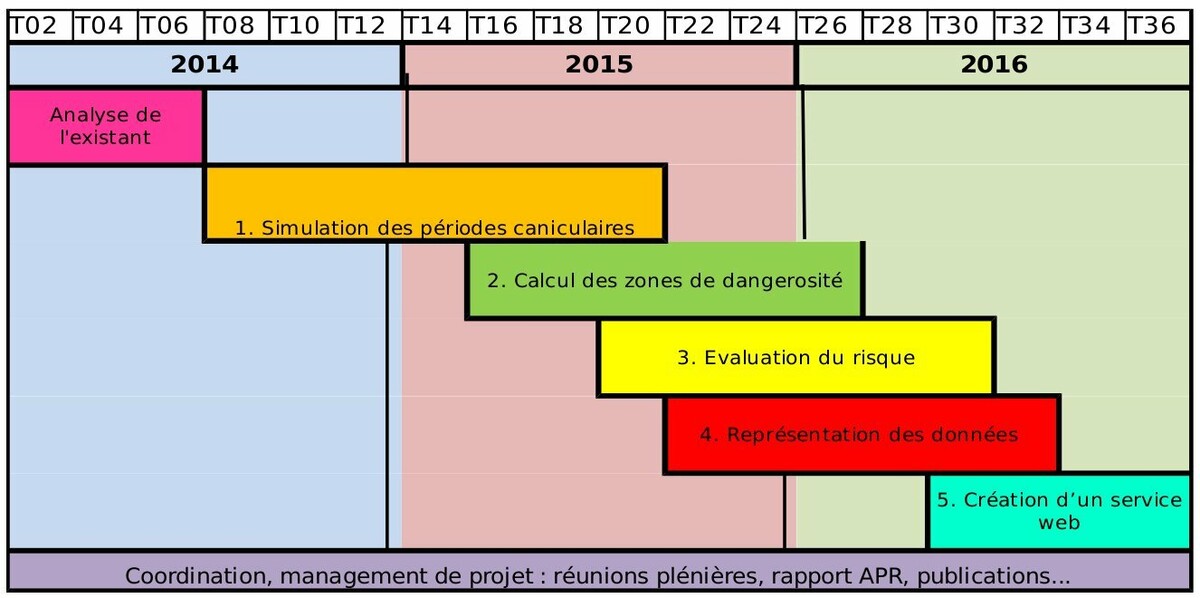
Project steps and description
The project has been structured into 5 steps: simulation of heatwave periods, calculation of danger zones, risk assessment, data representation, and finally the creation of a web service.
First results
The following diagram illustrates the current positioning of the project.
The TEB model from Météo France that we use in the project takes as input:
- morphological grid cells: spatial divisions characterized by buildings (type, layout, height, orientation), vegetation, etc.
- weather forecasts calculated either from data from an observation weather station (then spatialized with a physical conceptual model to account for the urban heat island) or by Méso-NH (as part of the project), or by the operational AROME model over France (for standard forecasting).
Based on these data and geographic data (such as BDTopo 3D), the RepExtrem project aims to:
- reproject forecast data into space to better highlight them and facilitate contextual post-analyses,
- represent the dynamics of phenomena from a data series and highlight critical areas,
- supplement grid-based forecasts with estimates of local temperature variations. This last point uses existing knowledge on heat distribution, complemented by measurement campaigns carried out during the project.
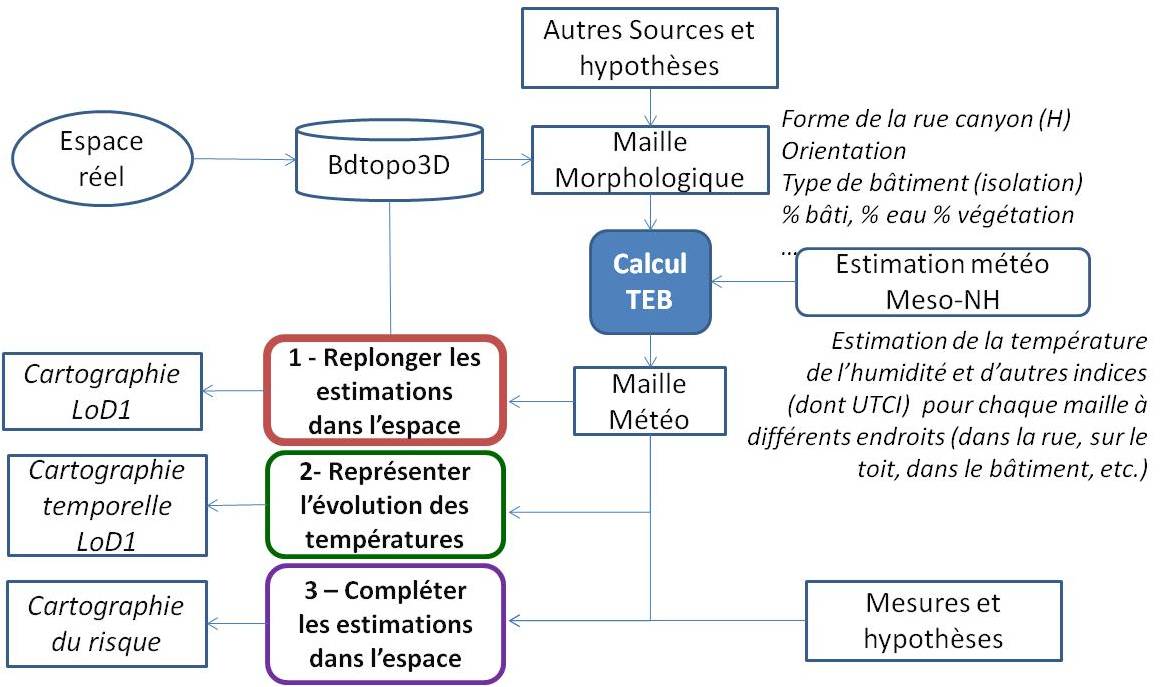
Enrich and map meteorological data and associated risks © IFSTTAR, 2015
Heatwave simulations in Paris in July 2010 (Météo-France), data representation and analysis (IFSTTAR)
Météo France simulated the 2010 heatwave in Paris. These new outputs from the TEB model with (250m)² grid cells enabled studies at the neighborhood level. This new temperature database, with hourly data between July 5 and 11 over central Paris (a period during which France experienced a heatwave), makes it possible to map street canyon temperatures at 2 meters above ground in central Paris using a GIS. This allows for visualization of the spatial distribution of the heatwave phenomenon as well as identification of the chronology of air warming and cooling. This processing makes it possible to integrate temporality to identify critical zones corresponding to areas where the temperature is particularly high for a certain period of time.
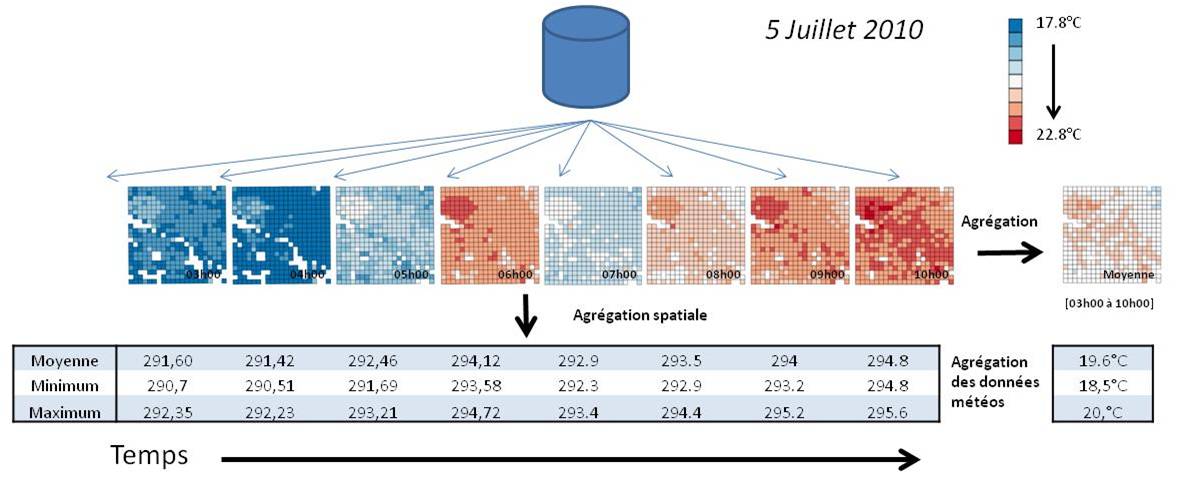
Representation and analysis of a temperature series in Paris © IFSTTAR, 2015
Design of a data schema adapted to heatwave risk (version 1)
A first data schema is being designed. The goal is to structure the data efficiently to dynamically monitor a heatwave using forecasts and measurements. Since the danger depends on both intensity and duration, it is necessary to move from states to durations and to track temperatures over time at the grid cell level to determine if a potential heatwave situation is developing, as well as its severity and spatial coverage. As this is a monitoring process, the indices are calculated and updated regularly.
- The GridCell-weather-duration object describes the temperature in a grid cell over 7 consecutive hours.
- The GridCell-heatwave-monitoring object tracks the state of each grid cell according to the specifications of a possible heatwave. The GridCell-heatwave-monitoring object is updated every 12 hours by integrating data provided by the GridCell-weather-duration. It thus updates its indices, including average, minimum, and maximum temperatures since its creation, as well as duration and severity. If, however, the GridCell-weather-duration is not heatwave-like, the GridCell-heatwave-monitoring object is reset. Flexibility is included to account for heatwave recurrences.
- The heatwave-zone corresponds to connected objects of the GridCell-heatwave-monitoring class. This is a spatial aggregation.
- The heatwave-history is intended to store objects and relevant information to describe heatwave zones.
Ongoing research focuses on improving this model and its associated functions, including the calculation of indices by integrating InVS recommendations.
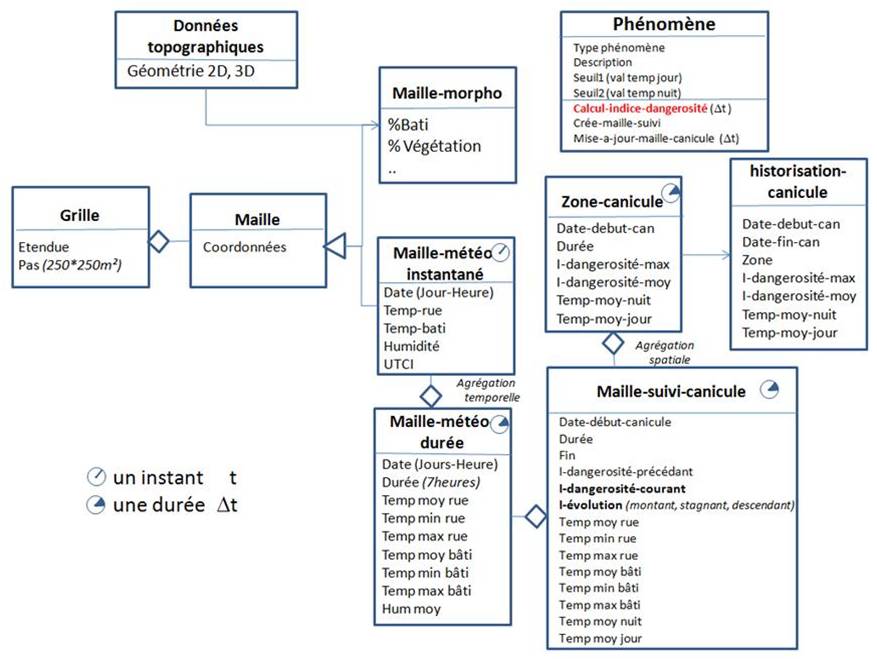
Data diagram to represent heatwave risk © IFSTTAR, 2015
Temperature measurements in Paris in August 2014 and July 2015
To be able to detail local temperature variations more precisely, we carried out two series of measurements in a dense area of Paris. The objective is to study the temperature differences between indoors and outdoors, in the north and south areas, and according to the floor level to observe temperature variations. Indeed, given the risks to people, it is essential to estimate both outdoor and indoor temperatures during heatwaves. As not all buildings have the same characteristics (orientation, number of exposures, floor, insulation, ventilation), the aim is to estimate possible temperature scenarios for different situations.
In 2014, we placed 14 Tynitag sensors (some of which were outdoor sensors placed in naturally ventilated shelters) on a non-air-conditioned building in central Paris located in a canyon street. These sensors were placed on the north and south sides, inside and outside the building, on 4 different floors (from the 3rd to the 6th floor). Measurements were taken every 30 minutes for 8 days (from August 9 to August 14, 2016).
To complete the analyses, in 2015, 20 sensors were placed in 5 apartments and nearby (indoors and outdoors) between June 29 and August 1, 2015. Météo-France temperatures at Montsouris were also recorded.
The following figure illustrates the indoor and outdoor temperatures in two non-air-conditioned Parisian apartments. A first analysis shows that for two apartments in the same neighborhood, the indoor temperatures were significantly different. The top graph corresponds to the outdoor (blue) and indoor (red and orange) temperatures of an apartment in a canyon street, on the 4th floor, with double exposure (one south, one north). The bottom graph corresponds to the outdoor (orange) and indoor (blue) temperatures of an apartment on the 3rd floor overlooking a courtyard, never exposed to the sun and with only one exposure. While thermal amplitudes are greater in the first apartment, the second experiences very high temperatures both day and night, and the cooling at the end of July appears later than in the other apartment. These graphs illustrate that the heatwave phenomenon is not experienced in the same way in the two apartments. For the courtyard-facing apartment, the temperature does not drop at night.
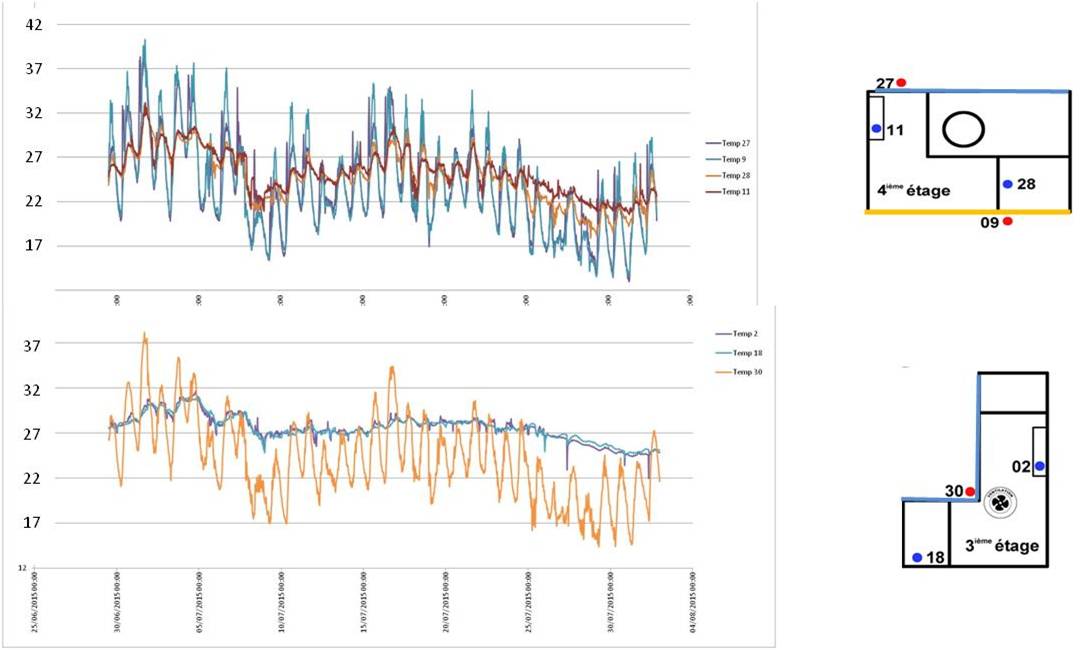
Indoor and outdoor temperatures during the 2015 heatwave in Paris for two apartments © IFSTTAR, 2015
Regarding outdoor temperatures, the following graph illustrates the differences between temperatures recorded in a park on the edge of Paris (Météo-France station at Montsouris) and those taken in the streets, in the city center. On the hottest days, these differences can reach 6 degrees depending on the configuration.
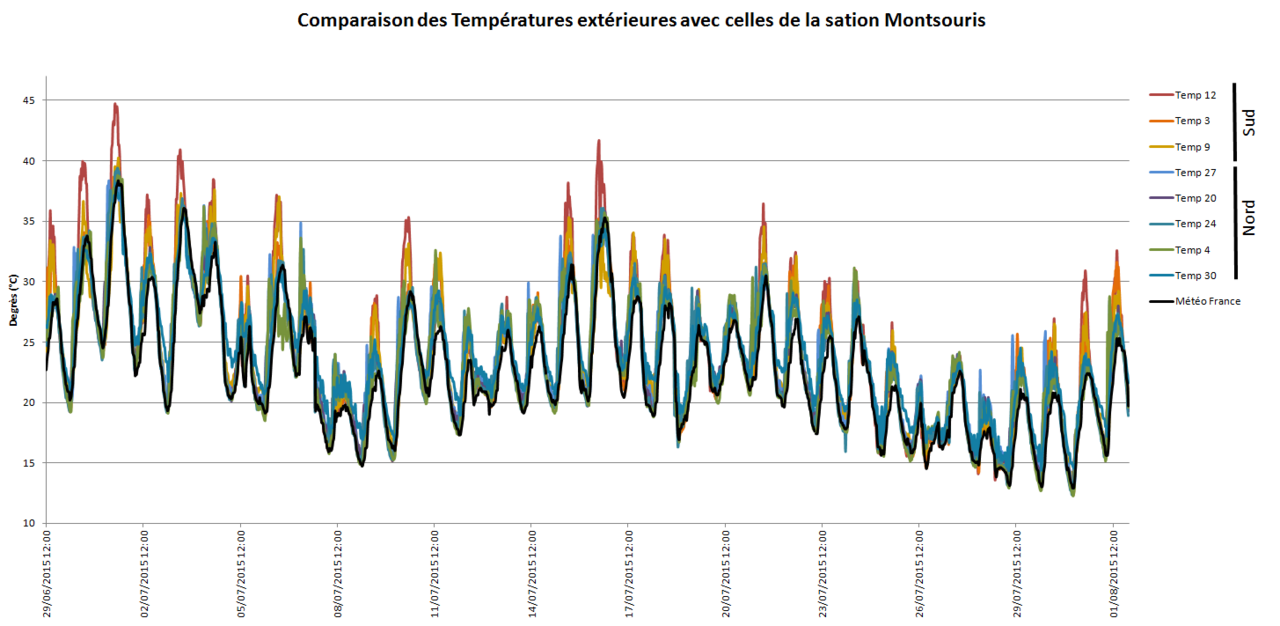
Example of differences in outdoor temperatures in Paris in July 2015 © IFSTTAR, 2015
Publications
Pinson L., Ruas A. Apport de la géomatique pour le risque caniculaire SAGEO 2014, Grenoble
Pinson L , Ruas A. Chancibault K., Masson V. Une meilleure connaissance et estimation du risque caniculaire en zone urbaine dense. Conférence AIC (Association internationale de climatologie) 1-3 juillet 2015 (Liège - Belgique)
Pinson L , Ruas A. Chancibault K., Masson V. Reconstruction de l'objet canicule : modélisation et représentation graphique. Actes de la conférence SAGEO (2015)
Pinson L. Représentations des mesures urbaines en période caniculaire. Intervention lors du colloque de l’université Diderot sur la Variabilité et changements climatiques : impact sur les sociétés (2015)
Pinson L . Changement climatique et santé : Quels risques? Quels remèdes? De la donnée climatique à un indice de dangerosité pour le risque caniculaire. Intervention lors du congrès SFSE (2015)

AnneRuas
Chercheur en Géographie (smart cities, climat urbain, gestion des dechets, artificialisation ) & Géomatique (modélisation, simulation, représentation)
+33 (0)1 81 66 80 99Marne-la-Vallée