
Synapse
Funded by the ANR
Partners: CNRS, École Polytechnique, ONERA, Aix-Marseille University, Paris-Sud University
Objectif
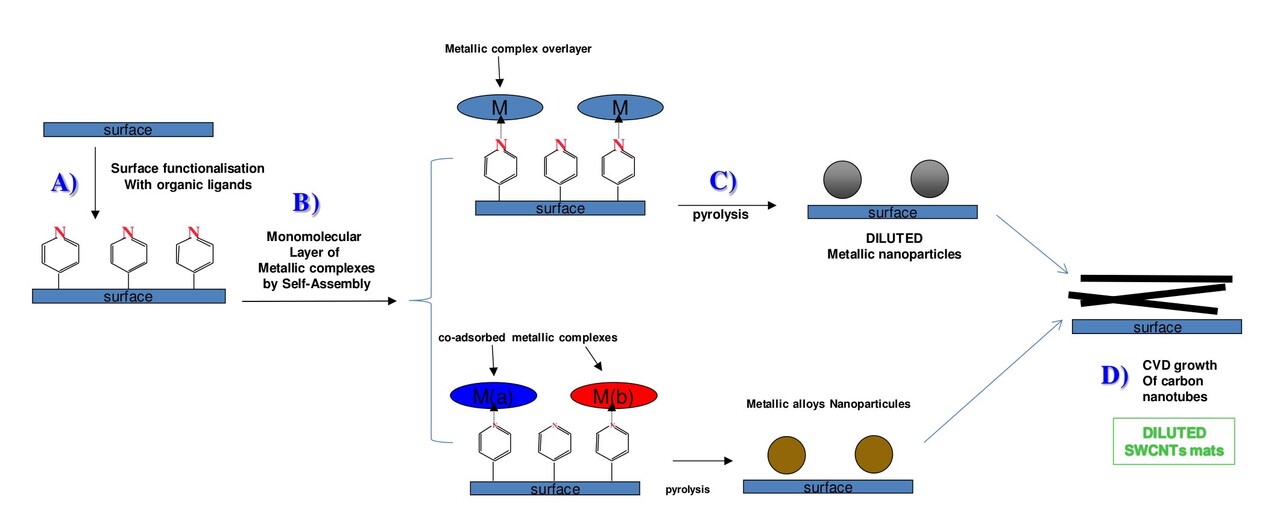
The objective is to develop a carbon nanotube fabrication technique that allows control of their electronic properties directly during synthesis. This will enable the effective use of carbon nanotubes in various electronic devices without the need for a sorting step. Our approach is based on controlling the size and chemical composition of the catalysts, using a new process that combines surface chemistry and coordination chemistry. Extremely promising preliminary results clearly show that this objective is perfectly realistic. This experimental approach will be complemented by numerical simulation to improve the selectivity of the synthesis towards a specific type of nanotube (metallic or semiconducting). In this project, we will focus on understanding the selectivity of carbon nanotube synthesis from bimetallic catalysts. To this end, a significant part of the experimental work will be devoted to the structural study of nanoparticles, nanotubes, and their relationship, using a powerful array of investigative techniques (HR-TEM, STEM, HREELS, and XPS). These results will be correlated with the properties of the obtained nanotubes. The growth mechanisms will be studied by numerical simulation. New tools will be developed to simulate bimetallic catalysts, whose use seems crucial for the synthesis of nanotubes with specific properties. This project will thus help to eliminate one of the major obstacles to the large-scale use of carbon nanotubes in various micro/nanoelectronic applications.
Work program
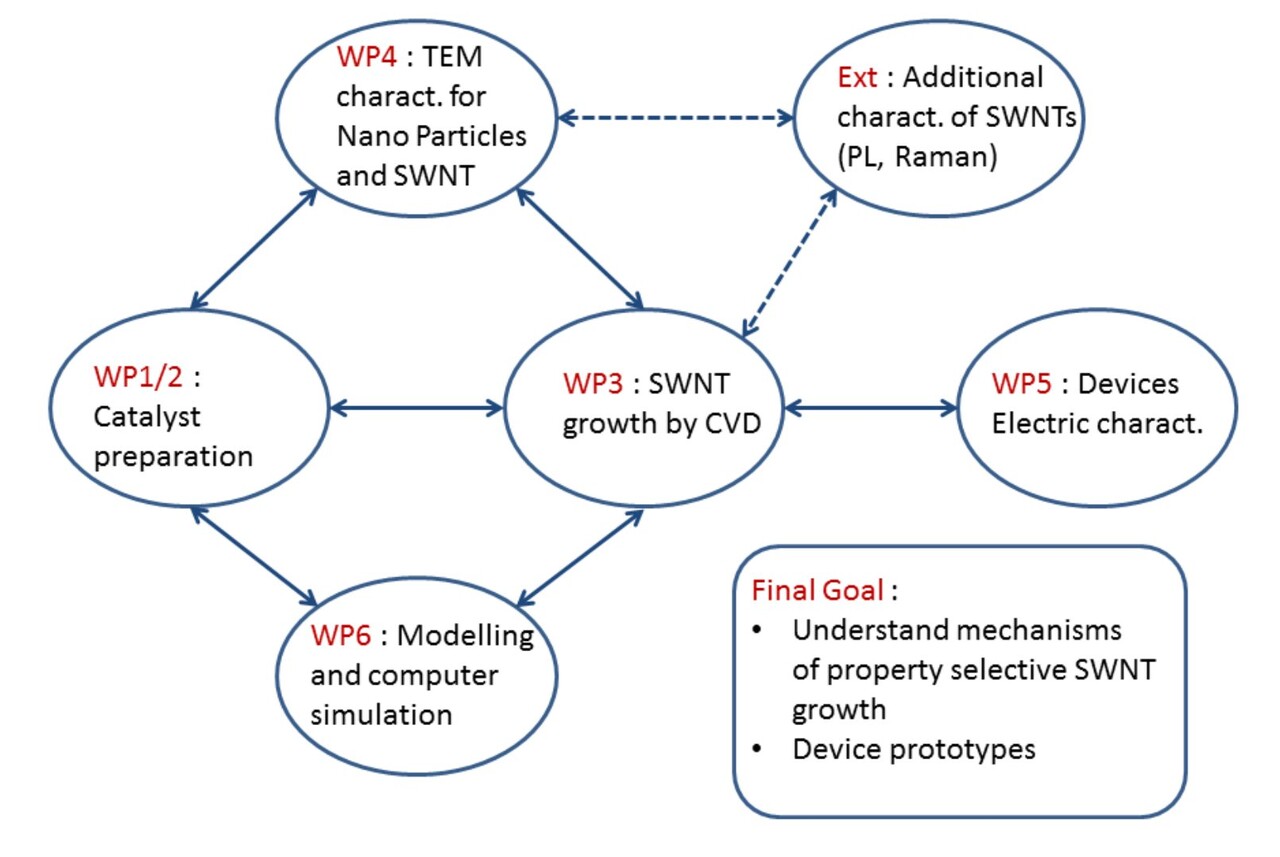
The project will proceed along two paths, one experimental and the other theoretical, mainly based on numerical simulation, to achieve controlled direct synthesis of carbon nanotubes and to understand the mechanisms involved. These two approaches will interact closely, particularly thanks to the presence of simulators and experimenters with extensive experience in collaborative work. The experimental work is organized into three tasks: catalyst synthesis, nanotube synthesis by CVD, and detailed characterization of the catalysts before and after CVD, followed by carbon nanotube synthesis. These three tasks will be in constant interaction, carried out by a PhD student who will work with all partners. Since the goal is to find the catalytic system with the best selectivity, these three tasks will be repeated until the desired result is achieved. Each of these experimental steps will have a theoretical counterpart. After consultation with the experimental partners, one or two particularly effective bimetallic catalytic systems will be selected for detailed study. The growth mechanisms of the nanotubes will be analyzed in detail, relying on Grand Canonical Monte Carlo calculations based on a tight-binding energy model, which is a unique feature of the consortium partners (LEM/CINAM). Extending the calculation codes to bimetallic systems will allow for better alignment with experiments and a deeper understanding of the origin of selectivity.
Scientific, technical, and economic impacts
Selective synthesis of nanotubes is a highly sought-after goal, for which progress is real but still slow. It is essential to fully understand the mechanisms involved in order to hope to control them. The approach we propose is original and very promising. Basic electronic devices have already been fabricated and tested using this method, which leverages molecular chemistry resources. In a context where several teams, mainly foreign, have reported partial and rather poorly reproducible results without understanding the mechanisms, the SYNAPSE project proposes a rational approach that will lead to results that can be extended on a large scale. The use of nanotubes with specific properties in various applications (thin-film transistors, transparent conductive layers, metallic fibers based on conductive nanotubes, etc.) has already been well explored. What remains is to master the fabrication of these nanotubes, which is what we propose.

fatimabouanis
Marne-la-Vallée