
Micad'Eau
Project funded by DGCIS, the Île-de-France region, and the Yvelines General Council
Partners: Advitam, Suez Environnement, EFS, IFSTTAR, ESIEE
As part of the Micad'eau project, the focus is on detecting anomalies (leaks, appearance of pollutants) in drinking water networks, and more specifically on reconstructing the flow in pipelines using inverse models and point measurements from sensors. However, despite increasingly powerful computing resources, solving the inverse problem is limited by memory size issues and excessively long computation times. This prevents any identification in "real" or "pseudo-real" time, as desired.
To overcome these difficulties, one approach is to use simplified models that allow for satisfactory approximate results within acceptable time frames.
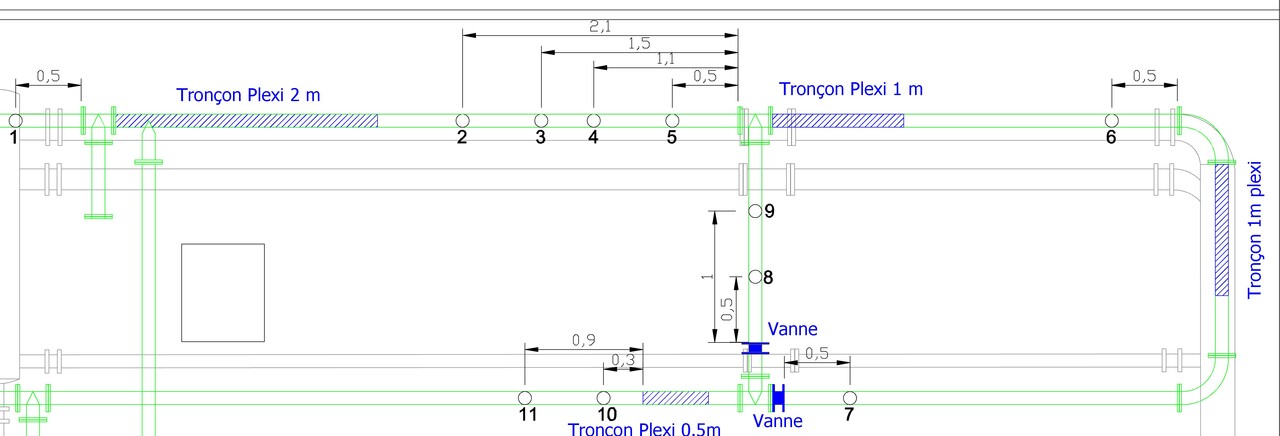
Reduction method
However, it should be noted that the equations we wish to solve depend on parameters used to identify specific configurations (geometry, physical properties, etc.). Reduction methods such as POD and CRB (certified reduced basis) often require direct access to the simulation code. Thanks to a non-intrusive reduced basis method, it is still possible to perform model reduction using a black-box software.
This method is based on the fact that the coefficients of the solution in the reduced basis can be calculated as the integral of this solution with the orthonormal reduced basis elements. The accuracy of these moments does not require convergence in energy norms but in weaker (negative) norms. Their approximation can therefore be optimal, while reducing the number of degrees of freedom, even in the case of a code that can only be used as a black box. It is not necessary to modify or even have access to the source code to implement this method, as all steps are performed externally.
In the following example, we want to vary the velocity amplitude at the inlet of a pipeline, between 0.01 and 0.5 cm/s.
The "Freefem++" software was used as a pseudo black box for solving the steady-state Navier-Stokes problem. It was implemented using the finite element method combined with a Newton method (to account for the nonlinear terms).
To validate the non-intrusive reduced basis method, solutions were computed on both a fine mesh and a coarse mesh.
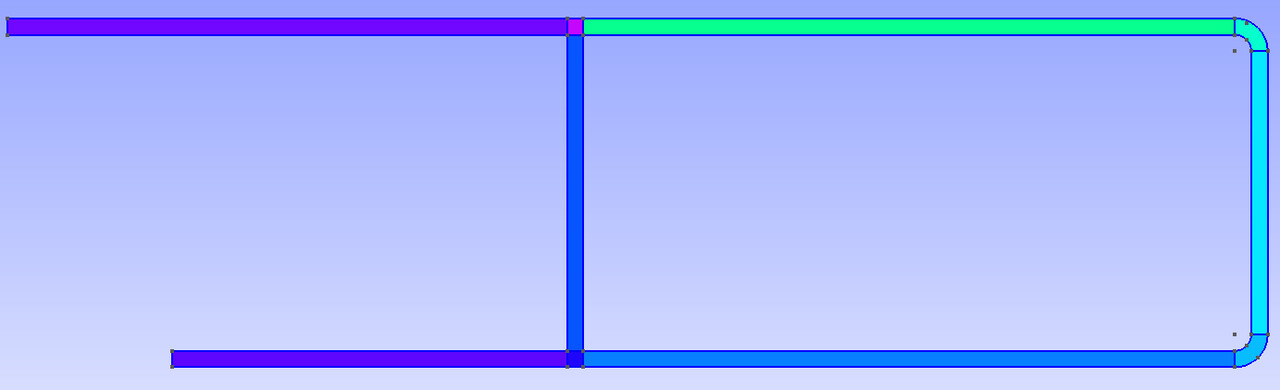
Fine mesh
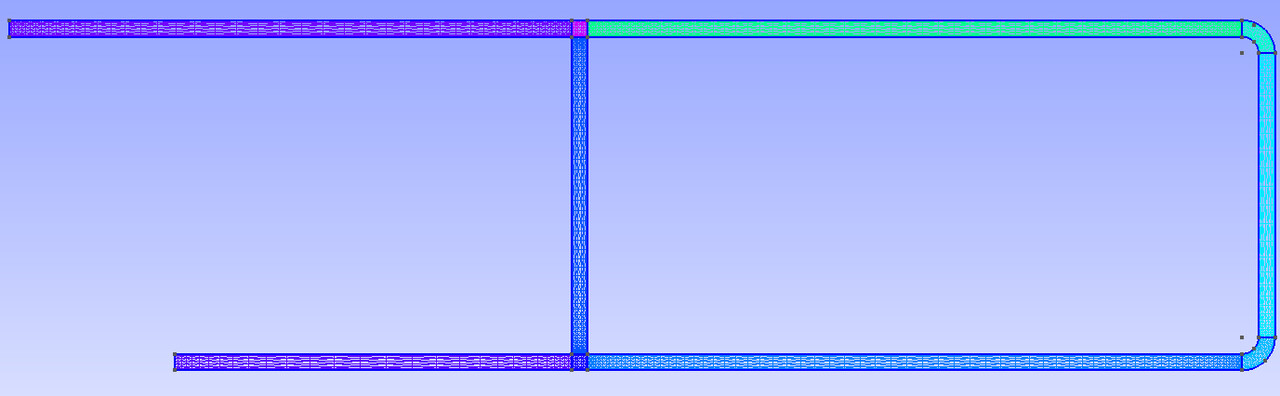
Coarse mesh
Inverse methods
The objective is to map the flow and chlorine concentration field in a drinking water network. To achieve this, we developed inverse methods using in-situ measurements and mathematical models: fluid mechanics equations and transport-diffusion-reaction equations. These methods are based on optimal control theory: the goal is to find the control parameters, e.g., velocity boundary conditions, that minimize a cost function representing the difference between numerical simulation and measurement. This minimization problem is solved using a gradient-based method, where the gradient of the cost function is efficiently computed using the adjoint state. Below, we present an overview of the work carried out.
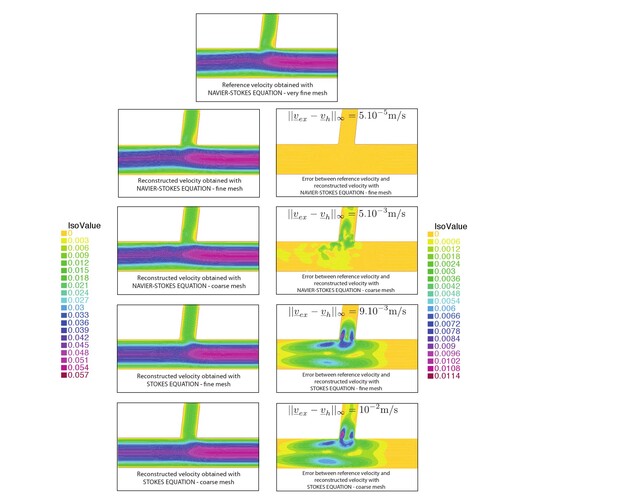
Reconstruction of unsteady flow by inverse modeling
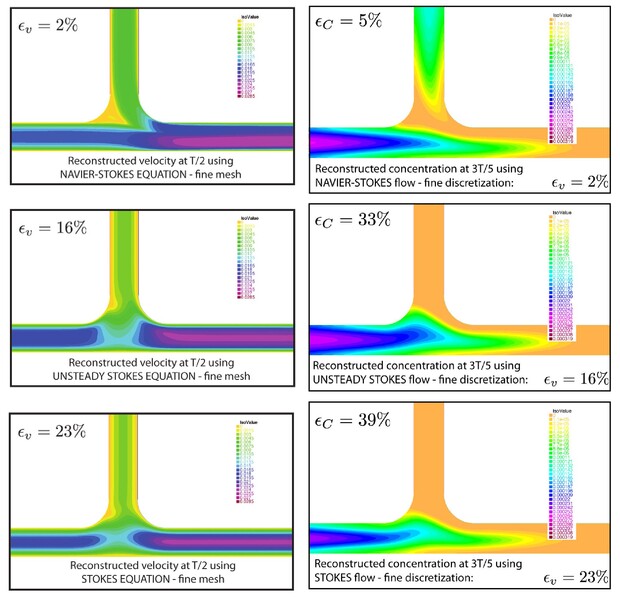
On the test case of a T-shaped junction, we used different physical models (Stokes equations, Navier-Stokes equations) in the reconstruction process. We showed that using a simplified flow model (Stokes equation) to reconstruct a Navier-Stokes type flow could result in a 20% error in the velocity field. To achieve an error of about 1% on the reconstructed velocity field in a drinking water network, a hybrid method was proposed. This method consists of reconstructing the flow throughout the network by inverse modeling with a simplified model (Stokes equation) and then performing a direct Navier-Stokes solution in the junctions.
Reconstruction of chlorine concentration by inverse modeling
An inverse method was proposed to reconstruct the 2D chlorine concentration field. The flow was assumed to be known. On the test case of a T-shaped junction, we studied the influence of several parameters on the quality of the reconstructed chlorine concentration field: e.g., the influence of discretization error in the transport-diffusion-reaction equations, the influence of uncertainties in the flow, and the influence of measurement errors. It was noted that a 20% error in the flow can lead to a 40% reconstruction error in the chlorine concentration field.
Optimal placement of chlorine sensors: application to a T-shaped pipeline
To determine the optimal placement of chlorine sensors for reconstructing the chlorine field, a computationally efficient numerical tool was developed. This tool is based on the solution of an adjoint problem. The method was illustrated on a T-shaped pipeline. This work was published in the international journal “Computers and Mathematics with Applications.”
Identification of the reaction kinetics constant in a drinking water network
In a drinking water network, chlorine reacts with many elements (organic, i.e. algae, and chemical) to ensure water quality. The reaction kinetics parameter of chlorine is one of the lesser-known parameters in the drinking water network. Thus, during Dr. Chabchoub's postdoctoral work, an inverse method was implemented to determine this kinetics constant from measurements and a physical model, i.e. transport-diffusion-reaction equations. By calibrating this parameter, we can obtain numerical solutions for the chlorine concentration field that are more representative of reality.
To solve this inverse problem, we used standard hydraulic engineering tools: the 0D-1D Epanet software with developments in C++.
JulienWaeytens
Directeur de Recherche
julien.waeytens@univ-eiffel.fr
+33 (0)1 81 66 84 53Marne-la-Vallée
RachidaChakir
Chercheur en Mathématiques Appliquées
+33 (0)1 81 66 84 36Marne-la-Vallée
PatriceChatellier
Chercheur
patrice.chatellier@univ-eiffel.fr
Marne-la-ValléeFrédéricBourquin
Marne-la-Vallée