
Smart Water Network
Project funded by DGCIS, the Île-de-France region, and the Yvelines General Council
Partners: Advitam, Suez Environnement, EFS, IFSTTAR, A3IP, ESIEE
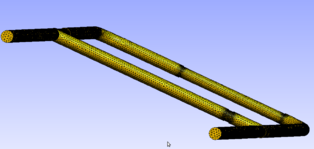
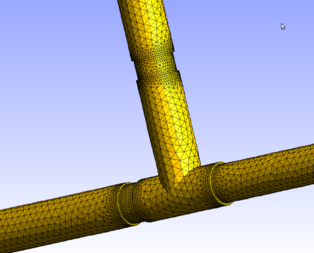
![[Translate to English:] Champ de vitesse](/fileadmin/_processed_/5/1/csm_SWN_3_7cb3f4b8f5.png "[Translate to English:] Champ de vitesse")
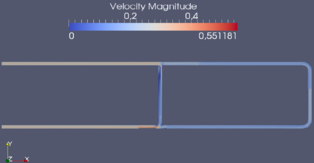
Work carried out on the inverse modeling of flows
During this project, we developed a flow reconstruction approach based on optimal control theory. The objective was to determine the velocity control boundary conditions (assumed parabolic over the section) that minimize the difference between the numerical simulation and the measurements. The main steps of the approach were as follows:
- Solution of the direct problem
- Solution of an adjoint problem
- Calculation of the gradient of the functional using the adjoint state
- Solution of the minimization problem using a descent method
On the 2D test case of a "T-shaped pipeline," we validated this method for a large number of flow models: steady Stokes, unsteady Stokes, and Navier-Stokes. In addition, the influence of discretization error and model error was studied. This work was published.
The previous method allows for relevant flow reconstruction. However, it is not suitable for real-time reconstruction. Therefore, we explored another approach based on the superposition principle. The idea was to perform as many calculations as possible "offline" and a minimum in real time. This approach was validated on the T-shaped pipeline test case and on two sections of city networks in France. In this part, we limited ourselves to linear flow models (steady Stokes and unsteady Stokes).

Work carried out on the inverse modeling of chlorine concentration
Similarly, we studied the reconstruction method for the chlorine concentration field in a known flow. In this case, the objective was to determine the boundary conditions of chlorine concentration (assumed constant over the section) that minimize the difference between the numerical simulation and the measurements. The method was applied to the test case of the T-shaped pipeline. We showed that the placement of chlorine sensors is fundamentally important.
Leak detection by nonlinear regression and factor analysis
In this method, it is assumed that, at the scale of a neighborhood for example, the operator has developed a hydraulic model to simulate the evolution of the network at any time, even in the presence of anomalies such as a pipe blockage or a leak. The neighborhood is assumed to have minimal instrumentation, but with at least two pressure sensors at the beginning and end of the network.
The developed method combines nonlinear regression techniques (which, in the case of empirical data, will actually be neural networks) and principal component analysis.

JulienWaeytens
Directeur de Recherche
julien.waeytens@univ-eiffel.fr
+33 (0)1 81 66 84 53Marne-la-Vallée
PatriceChatellier
Chercheur
patrice.chatellier@univ-eiffel.fr
Marne-la-ValléeFrédéricBourquin
Marne-la-Vallée